Chapter 1: The Evolution of Consciousness
In this series of articles, I will try to elucidate the links between consciousness, goals and goal hierarchies, and the mode of being that is most adaptive thriving in life, given the that we are conscious. I will begin with consciousness.
When and why did consciousness evolve?
What is the adaptive value of consciousness? When did it evolve? To answer these questions, we need to take an evolutionary lens to the problem of consciousness. The Attention Schema Theory (AST) of consciousness does just that and can perhaps provide some answers.
The theory suggests that consciousness arose as a solution to a problem faced by nervous systems: it is impossible to deeply process all of the incoming sensory information. Over millions of years, nervous systems, under environmental selection pressures, evolved to select between those signals that are important to the survival and reproduction of the organism and those that are not. Consciousness may thus be, if the theory is correct, a mechanism to select which information to fully process.
The journey to a full-fledged mechanism for selective attention began half a billion years ago, before the evolution of a central brain. The first noteworthy step in this lengthy process is the development of the most rudimentary form of signal selection. To understand when this feature emerged, we can compare animals. Specifically, we can compare animals which can selectively enhance signals to those that cannot and analyze their genomes to estimate the split between both species.
Consider the genus hydra, which are small, fresh-water organisms. Their nervous system is extremely simple and consists of a nerve net. A nerve net is a web of neurons spread over a region, and in the case of the hydra all over its body. The nerve net allows the hydra to respond to stimuli originating in the environment but not to detect the source of the stimulus. Thus, if poked, these simple animals will typically produce the same response regardless of the point of contact. The split between hydras and other animals seems to have occurred 700 million years ago. The ability to select between competing signals must have evolved shortly after that.
Interestingly, the ability to selectively enhance certain signals does not require a central brain and each sense – sight, touch, sound – can select independently between competing stimuli. One of the functions of a central brain is therefore to coordinate between the senses and direct the selecting capabilities of all relevant sensory organs to the same object. Think of a cat turning its head towards the direction of an incoming sound.
This coordinating function is executed in many animals by a brain region called the tectum. We can narrow down the period in which the tectum evolved because it seems to be absent in invertebrates while all vertebrates – fish, reptiles, birds and mammals – have one. Vertebrates evolved around 520 million years ago, during the Cambrian Explosion, therefore the tectum and thus the central control of attention must have evolved in this vicinity.
The way the tectum works is by constructing internal models. An internal model is a simulation that keeps track of the things that need to be controlled and allows for planning and prediction. Say a body needs to move forward in space. The tectum continually simulates the current state of the eyes, head, arms and legs and makes predictions about how these body parts will move next, and what the consequences of these movements are.
Around 350 to 300 million years ago a new brain structure – the dorsal cortex – began to emerge in reptiles. Birds and mammals evolved from reptiles and thus inherited their version of the dorsal cortex. In birds it is called the wulst and in mammals it is called the neocortex. The neocortex has radically expanded in humans and is like an upgraded tectum. Like the tectum, the cortex takes in sensory stimuli but can execute several functions depending on the context – looking away, making a sound, or storing the event in memory for future use.
Another important difference between the tectum and the cortex is the type of attention they control. Whereas the tectum directs overt attention – focusing the eyes, ears or nose towards something – the cortex seems to direct covert attention – directing the “spotlight” of attention towards something without directing the sensory organs towards that thing.
Where does awareness come from?
We now understand where attention comes from, and what its purpose is. It is the “spotlight”, which allows certain stimuli to be fully processed at the expense of others. It allows for a parsimonious allocation of resources to those things that are most important to process.
A burning question remains: how come we are aware of our attention? Attention is the differential selection and processing of certain signals over others. Awareness is the subjective experience of those signals. To be aware of X is to say that X is an object of subjective awareness. Most of the time these are closely linked: you are aware of what you are attentive to. But it is possible to separate the two.
Recall that in order to control the body the tectum must construct an internal model of it. Similarly, in order to control attention, the cortex must construct a model of attention. Like the internal model of the body, the internal model of attention simulates the “spotlight” and this is what provides us with awareness. After constructing a model of our own attention, the theory suggests we began constructing models of others’ attention.
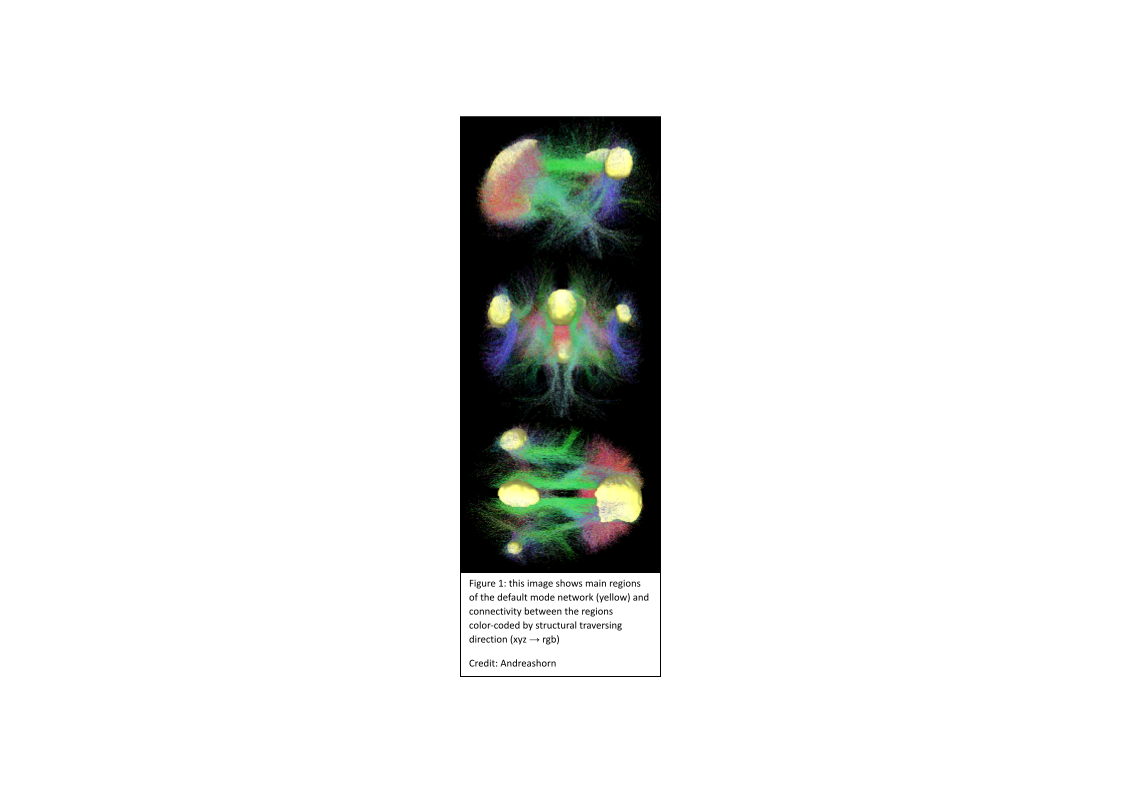 Figure 1: This image shows main regions of the default mode network.
The purpose of awareness
Good. We are now aware of ourselves and others. But what is the purpose of awareness? Why spend precious resources simulating attention? Awareness necessarily entails some notion of an “I”. Researchers seem to have located the self in the default-mode network (DMN) of the brain.
The DMN is active when a person is unfocused, such as when a person is daydreaming or mind-wandering. Its functions include three main areas: (1) the self, (2) thinking about others and (3) remembering the past and thinking about the future.
The purpose of conscious awareness may then be the following. We construct models of ourselves to understand who we are. We construct models of others, to understand if they are good or bad, to understand what they are thinking and feeling, to understand our place within a group. And we construct models about the past and the future to understand what has been, but also to set goals for the future.
In the next chapter of this essay, we will focus on the future planning capacities of the self.
Chapter 2: Goals and Perception
In this chapter, I will examine the relationship between consciousness and goals, and explain how goals, and ultimately values, are one of the fundamental mechanisms for attention.
We process information using a frame
Is our vision objective? Generally, are our perceptions objective? They aren’t. When we look out at the world, we don’t directly perceive what is “out there”. Information about the world is processed through a frame, presenting to our awareness a model of the world and not the world itself. Consider the famous checkerboard illusion.
The reason for this illusion is that visual system evolved to be capable of accurately detecting colors, even those in the shadows. In this artificial scenario, the visual system gets tricked and therefore corrects the perceived color to make it seem brighter than it actually is.
Consciousness is an error detecting mechanism
Sometimes, the information – be it visual, auditory, or conceptual – fails to fit in the frame. When this happens, the frame breaks and we become aware of the error.
Consider for example the following three questions:
- How many animals of each kind did Moses bring on the Ark?
- In the Biblical story, what was Joshua swallowed by?
- What is the nationality of Thomas Edison, inventor of the telephone?
Did you notice anything strange? Read them again and you will notice that they contain a mistake. It wasn’t Moses who brought animals on the Ark, it was Noah. It wasn’t Joshua who was swallowed by a whale, it was Jonah. And Thomas Edison didn’t invent the telephone, he invented the lightbulb.
When trying to answer these questions, your frame became focused on numbers, animals, and nationalities and not on examining the correctness of the questions. It’s only when there is a large discrepancy between our frame and the incoming information that we notice an error.
Your goals determine your frames and therefore perception
If we perceive the world through frames, what is it that sets these frames? We’re goal directed creatures. Humans do things for a reason and it’s precisely these reasons that set the frames. Your reasons for action, your goals, are therefore critical because they will determine what you see.
You set a goal, perhaps to do well at university, which comes with a set of assumptions: attend class, study regularly, and don’t party too much. These assumptions determine the frame: classes are opportunities to learn, your free time is a chance to study, and parties are mostly distractions. A different goal would lay out the world differently.
Goals must be organized in goal hierarchies
We are complicated creatures. We have many needs which we set goals for. One problem is these goals cannot all be satisfied at the same time. Goals need to be prioritized.
At the very top of the hierarchy, we have our ultimate goal: to become our ideal self. Our ideal self is an assemblage of fully realized values. Since values are at the top of the hierarchy, they will affect how I choose my goals and therefore how I see the world.
In the next chapter, I will describe the way of being that will allow you to realize your own ideal self.
Chapter 3: The Optimal Pattern of Behavior
In this final chapter, I will examine the optimal pattern of behavior. If we accept that humans have been trying to encode phenomenological reality into their stories, we can look for patterns that repeat across myths, legends, and religions.
Story patterns that repeat across time
The Story of Marduk
The story of Marduk is the Mesopotamian creation myth. Marduk, the storm god who has eyes on all sides of his head, is called upon to fight Tiamat (potentiality). He subdues her, cuts her into pieces, and from the pieces creates heaven and earth.
The Story of Osiris
Osiris was a primeval king who ruled wisely over Egypt. His brother Seth kills him. Isis, Osiris’ wife, gives birth to a son, Horus, the hero. When Horus is grown, he returns and confronts Seth. He descends to the underworld to rescue his father, Osiris, to which he gives his eye.
The Story of the Buddha
Gautama, the Buddha, leaves his walled garden to face the horrors of the world (death, decay). He becomes a master of tradition, then journeys into a dark forest where he attains enlightenment (Nirvana). He returns to civilization to disseminate the knowledge he has gained.
The Hero’s Journey
The pattern of these stories is remarkably similar. The Hero is called to adventure, voluntarily faces the destructive forces, faces a “death & rebirth” and returns with newfound knowledge. This pattern is still present in many popular contemporary products like The Lion King, The Lord of the Rings, and Star Wars.
What does the pattern mean?
The hero is us, and its guiding principle is the capacity to pay attention. In our life, we are constantly confronted with situations we know deep down we must engage with. By facing these situations voluntarily, we slice infinite potentiality into manageable pieces.
True challenges require a death and rebirth of personality. Once we understand, we must let cherished aspects of ourselves go, to become a new and improved version of ourselves. My final contention is this: because we are conscious, the pattern of the Hero’s Journey is the pattern that will allow us to thrive.