The Recursive Pattern
History is not a linear march toward progress; it is a series of recurring cycles. These patterns emerge because human nature is a constant. While technology and geography shift, the underlying mechanics of how people and societies respond to pressure remain unchanged. By synthesizing the work of Strauss, Howe, Dalio, Friedman, and Zeihan, we can map our current era and understand the structural forces at play.
The “Hero’s Journey” described by Joseph Campbell isn’t just for mythology. It functions as a blueprint for how societies navigate crisis. We are currently at a juncture where the old institutions are failing, and a new cycle of transformation is beginning.
The Cycles of Rise and Fall in History
Dominant powers follow a predictable trajectory of economic and social dynamics. Ray Dalio’s analysis of the Dutch, British, and American empires reveals a clear pattern of ascension, dominance, and eventual decline.
The Dutch Empire emerged from the collapse of the Habsburg Empire by harnessing capitalism and maritime innovation. Through the Dutch East India Company and the unification of currency via the guilder, they dominated the 17th century. However, their decline was precipitated by a shift from production to consumption, military overextension, and excessive debt, leading the British pound to eventually replace the guilder as the global reserve currency.
The British Empire followed a similar path, beginning in the 1600s. The establishment of the rule of law over the monarchy fostered intellectual and economic growth, culminating in the Industrial Revolution. By 1870, Britain commanded a massive share of global income and territory. Yet, like the Dutch before them, they eventually succumbed to the historical cycle of decline.
The United States rose to global leadership following World War II, with the dollar replacing the pound. While the U.S. saw immense growth post-1776 and after the Civil War, it now grapples with political division, socioeconomic inequality, and a departure from a gold-backed currency. Current metrics suggest the U.S. is approximately 70% through its current cycle, entering a phase often marked by internal friction and systemic transition.
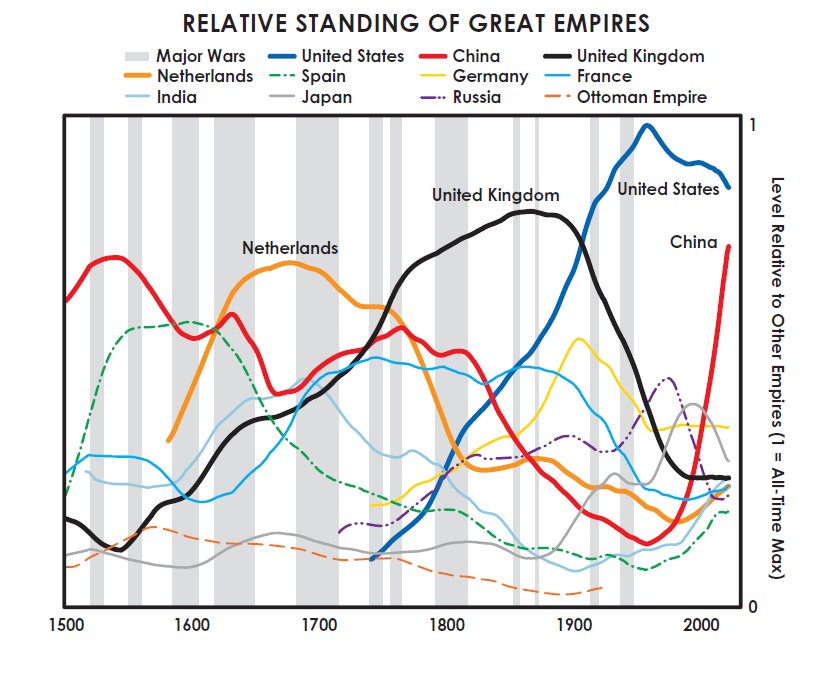
A nation’s standing is determined by eight key markers: education, competitiveness, innovation, economic output, trade share, military strength, financial center strength, and reserve currency status. These cycles provide the essential context for navigating the current era and understanding the trajectories of emerging powers.
The Three Factors Affecting Societies and Their Relationship to Intersocietal Dynamics
Societies follow a predictable “Big Cycle” of roughly 250 years, defined by the interaction of economic, social, and institutional forces. This cycle marks the pendulum swing between a nation’s ascendance and its eventual decline, determining its position on the global stage.
The economic driver is the most visible, consisting of intertwined debt cycles. The long-term debt cycle spans approximately 100 years. It begins with low debt and high productivity, leading to wealth creation and rising living standards. At its peak, however, success often breeds complacency. Innovation slows as the focus shifts from creation to consumption. High debt eventually triggers a systemic crisis, often resulting in economic collapse or war before the cycle resets to a low-debt phase.
Operating within this is the short-term business cycle, lasting about eight years. This cycle is driven by interest rate adjustments. When growth slows, central banks lower rates to encourage borrowing. This continues until interest rates hit the “zero bound,” at which point banks resort to quantitative easing or “printing money.” This transition often signals that the long-term debt cycle is nearing its end.
Social and institutional cycles run parallel to these economic shifts, lasting about 80 years, or the length of a human life. Strauss and Howe suggest these cycles oscillate between periods of high consensus and intense crisis. Prosperity creates complacency; as a society grows wealthy, the work ethic that built that wealth diminishes. Generational worldviews become rigid, often clashing with new realities and creating tensions that require a transformative “hero’s journey” or crisis to resolve.
Institutions reflect the conditions of the era in which they were born but evolve much slower than the public. Over time, they become bloated and unable to adapt to modern needs. This lack of flexibility eventually triggers a functionality crisis, necessitating a total institutional renewal.
These cycles are multidirectional. Economic inequality can spark social unrest, which in turn forces the renovation of stagnant institutions. Conversely, rigid institutions can worsen an economic downturn by failing to implement necessary reforms. Understanding these interlocking rhythms explains the historical shift between unipolar world orders and periods of multipolarity, providing a framework for predicting future global trends.
An Examination of the Current World Leader: The United States
The influence of the United States over the past few decades makes it a prime example for understanding how these cycles manifest within a nation. To deeply understand the trajectory of the United States, we turn to the cycle theories proposed by George Friedman. He offers two distinct yet intersecting cycles: the eighty-year institutional cycle and the fifty-year socio-economic cycle. Both are instrumental in shaping the country’s history and providing a lens to view its future.
The institutional cycle focuses on the evolving relationship of the federal government to its constituents: the states, the economy, and the society. Throughout American history, three major instances of this cycle can be discerned:
- The Revolutionary War cycle (1787-1865) saw the creation of the federal government, laying the institutional groundwork of the nation.
- The Civil War cycle (1865-1945) involved a redefinition of the relationship between the federal government and the states, largely influenced by the issue of slavery and state rights.
- The World War II cycle (1945-2025) is characterized by redefinitions of the relationship of the federal government to the economy and society, spanning from post-war economic boom to the digital age.
Interweaving with the institutional cycle is Friedman’s socio-economic cycle, which underscores significant shifts in the socio-economic fabric of the country. This cycle highlights:
- The Washington Cycle (1783-1828), marked by the founding of America and establishment of its initial institutions.
- The Jackson Cycle (1828-1876), defined by crucial banking laws that catered to the needs of the western settlers.
- The Hayes Cycle (1876-1929), which saw the creation of a pure gold standard.
- The Roosevelt Cycle (1932-1980), marked by the GI Bill’s social impact enabling veterans to attend college and university. During this cycle, the United States rose to prominence as a world leader, in conjunction with the global power shifts outlined in the “The Cycles in History” section.
- The Reagan Cycle (1980-2030), characterized by policies favoring entrepreneurial challenge to large corporations, hence promoting competition and innovation.
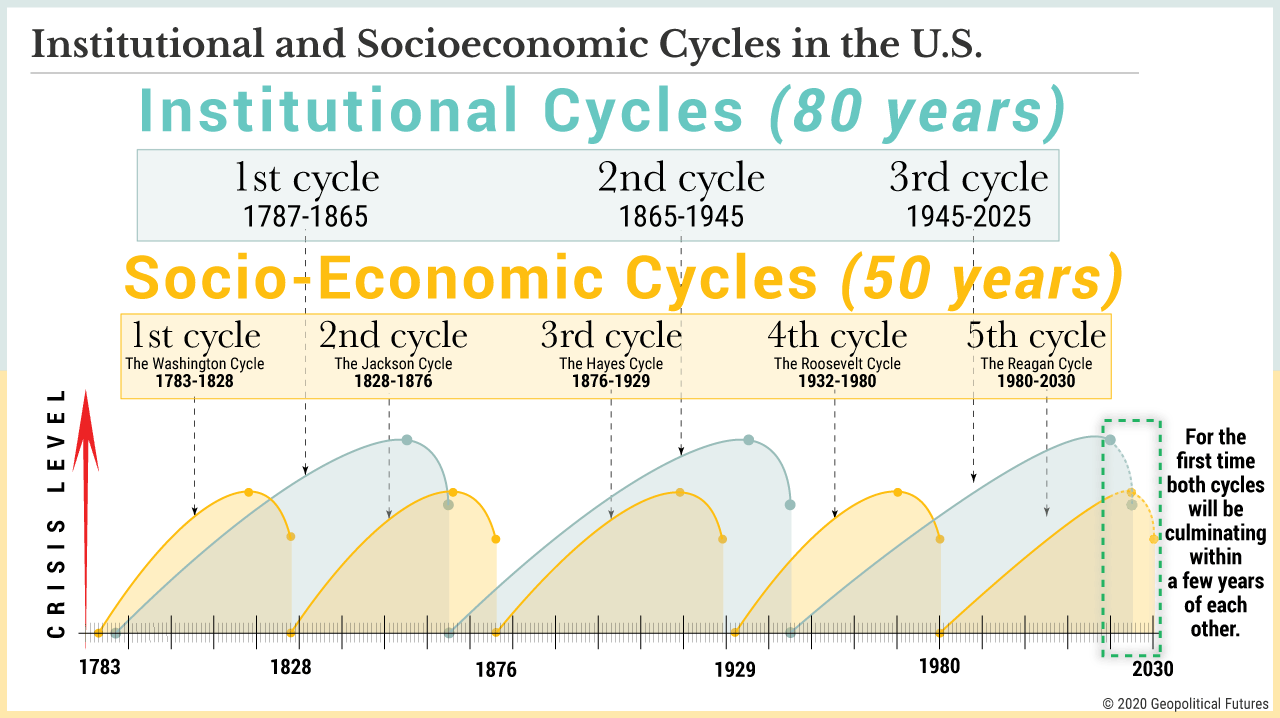
According to Friedman, these two major cycles, which can be seen above in the illustration created by Geopolitical Futures, are converging in the late 2020s, heralding a period of significant change and transformation for the United States. This convergence may result in upheaval and potential conflict, but it also opens up possibilities for increased strength, stability, and power in the world. The way the United States navigates these shifting tides could have profound implications for its standing in the global arena and, in turn, the shape of the world order.
Having understood the critical juncture which the United States faces, and the potential ramifications a crisis could have on countries in it’s sphere of influence, let us examine the shifting tides of current world order, before contemplating what shape the future world order might take.
The Shifting Tides of The Current World Order
The world order, much like the forces shaping individual nations, is never static. It is subject to continuous ebb and flow, driven by myriad geopolitical, economic, and social factors. Today, we’re witnessing a significant transformation, a shift from a unipolar world, dominated by the United States, towards a multipolar world, where power is more evenly distributed among several nations, with the US and China at the helm.
The rise of China is becoming increasingly apparent across multiple spheres. Its Gross Domestic Product (GDP) and relative standing index is now rivaling that of the US, signifying its ascendance as an economic powerhouse. Countries are rushing to join the BRICS bloc - an alliance of five major emerging economies: Brazil, Russia, India, China, and South Africa. In a testament to the growing influence of China, several nations are gradually abandoning the US dollar in favor of other currencies for certain trades, further evidence of the ongoing shift in the global economic landscape.
Moreover, there is a growing disenchantment with the role of the US as the ‘world police’. Instances of transgressions, perceived abuses of power, and the weaponized use of the dollar and the SWIFT payment system have led many countries to call for a more balanced and equitable international system, free from unilateral dominance.
All of these shifts can be viewed through the lens of the cycles and factors discussed earlier. As nations navigate their economic, social, and institutional cycles, these internal dynamics are mirrored in the global arena. From the rise and fall of empires to the ascendance of emerging powers, the interplay of these cycles shapes the global order.
As mentioned above, to gauge the strength and influence of empires or nations, we often turn to eight key determinants: education, competitiveness, innovation and technology, economic output, share of world trade, military strength, financial center strength, and reserve currency status. Each of these determinants reflects a vital aspect of a nation’s power and wealth.
It’s crucial to note that these determinants tend to rise and fall in synchrony. As a country innovates, its education and competitiveness improve, leading to greater economic output and an increased share in world trade. This, in turn, bolsters its military strength, the power of its financial centers, and the status of its currency. Conversely, a decline in any of these areas can precipitate a broader decline, potentially heralding the descent of an empire.
Observing the US and China, we can use these indicators to understand the underlying dynamics and trajectories of these countries. They provide key insights into the shifting tides of power and wealth, giving us a glimpse into the contours of the emerging world order. This new era, marked by increased multipolarity, promises to be one of dynamic change and heightened complexity, demanding a nuanced understanding of these intricate cycles and their interplay on the global stage. Now that we have a grasp of the current powers’ trajectories, let’s start envisioning what the unknown future might bring.
Envisioning The Uncharted Waters Of The Future World Order:
Predicting the future involves weighing different structural possibilities.
Ray Dalio envisages a significant upheaval in the financial realm, with the US dollar losing its long-held status as the world’s reserve currency. What might replace it? One viable candidate could be a gold-backed Renminbi. This shift mirrors China’s ascent as a global economic powerhouse. This transformation would likely start slow, gradually gaining momentum before reaching a tipping point, mirroring the nature of most disruptive shifts.
Parallel to this financial transition, Dalio predicts an increasingly assertive China challenging the US’s geopolitical hegemony. This competition might even escalate into war, with Dalio postulating that China could have the upper hand due to the US’s crippling debt burden.
On the other hand, Peter Zeihan sketches a different contour of the future world order. He foresees the US slowly withdrawing from its global role as the guarantor of free trade, propelling the world into an era of increased US isolationism. Contrary to Dalio’s view, Zeihan doesn’t see China stepping up to the superpower plate due to its low birth rate and looming demographic challenges.
In the absence of the US’s assurance of free trade, Zeihan anticipates a reversion to an earlier global structure, reminiscent of the early 20th century. Countries may transform into ‘empires,’ which can be seen as ‘vertically integrated countries’, which secure their raw material requirements by establishing close alliances with source countries.
In this scenario, the global trade framework we’re accustomed to may recede, making way for more localized trade networks. This shift could drastically alter economic dynamics worldwide, leading to profound implications for international politics, economics, and society.
It’s crucial to remember that these predictions, though insightful, are not definitive. The future is laden with uncertainties. Factors such as technological breakthroughs, unexpected geopolitical events, and significant social changes can drastically modify the trajectory of the world order. As we peer into the future, the continuous interplay of these variables, both known and unknown, keeps us alert and adaptable, ready to navigate the unpredictable waters of global dynamics.
Conclusion: Navigating the Cycles of History
These cycles persist because they are rooted in human behavior, which remains consistent across history. The rise and fall of civilizations are not random events but the result of predictable economic and social rhythms. While the transition from one cycle to the next often brings instability, it also provides the necessary ground for renewal.
Societies, like the archetypal hero, have the capacity to rise from these challenges stronger than before. Understanding these patterns allows us to view current crises not as isolated failures, but as a necessary part of a broader historical waltz. By recognizing these rhythms, we can better navigate the difficult but inevitable process of structural rebirth.