Introduction
In an era of fake news, misinformation and zealous activism truth has never been as important. But what is truth? Truth is one of those concepts which has been discussed for millennia in philosophy, art, religion and science. Is truth given by God? Is it something “out there” waiting to be discovered? Is it something we all agree upon, a social construct?
Despite its many meanings and definitions, truth is important because it is what enables beliefs, assertions and declarative sentences to be accurate descriptions of the world. That is, truth is a precondition of knowledge. Knowledge is important too because knowledge is, among other things, what allows our actions to have their intended consequences. True knowledge is like entering the correct address on a GPS: it allows us to arrive at our destination, whereas falsehoods would lead us astray.
In this essay, I will attempt to develop an understanding of truth and knowledge grounded in how we, as humans, see the world. I propose that truth is the correct joining together of a duality; material qualities with immaterial substrates, and that this good joining constitutes knowledge. I will show that this conceptualization of truth and knowledge is grounded in philosophy, science and in ancient and modern religious thought.
In ancient and modern religions thought
Many ancient religions and belief systems believed the world was made of two substances, a duality. In the most ancient cosmogony we know of, that of Mesopotamia, the universe is created from the union of Apsu, god of Freshwater, and Tiamat goddess of Saltwater. Apsu is the begetter of forms. He is the plan, or the blueprint, whereas Tiamat is said “to have given birth to them all”. She has given physical form to those blueprints. The Mesopotamian duality is freshwater and saltwater, or immaterial forms and material instantiations of those forms.
Interestingly, in the second part of this creation myth, the world is set off balance when Apsu is murdered. Tiamat becomes chaotic and destructive and is killed by the Mesopotamian culture hero Marduk, who makes the Heavens and the Earth, a new duality, from her body, restoring balance and creating the world that humans inhabit.
Dualities are quite common in religious thought. Consider the “Cosmic Egg”, a common mythological motif which is found in the creation myths of many cultures such as in Vedic, Zoroastrian, Mandaeism, Greek, Egyptian, Phoenician, Chinese, Finish, Polynesian, and Dogon mythology. In many instances, the cosmic egg precedes the universe, and either the universe, or a primordial hermaphroditic being is born when the egg is hatched. The symbolism of the egg can be understood as the unification of two complimentary principles (the yolk and the white) from which existence emerges.
For example, in Vedic mythology, the Upanishads explains that the cosmic egg floated around in emptiness for a while before breaking into two halves which formed Dyaus (Heaven) and Prithvi (Earth). In Chinese mythology, the universe began as an egg, symbolizing the state of Taiji: the undifferentiated oneness before Yin and Yang. Inside the egg was born a hermaphroditic giant named Pangu, who broke the egg into two halves. The upper half became the sky, while the lower half became the earth.
In modern religion too we see the universe created as dual principles. In the Bible, Genesis 1:1 we read: “In the beginning God created the heavens and the earth” and in the Qu’ran [7:54]: “Indeed your Lord is Allah Who created the heavens and the earth in six Days […]”.
In philosophy and science
What are these religions on about? What do these dual principles mean? Clearly, these principles must be important if they are so widespread.
Some philosophers have also developed the idea that the “world” is formed of two principles. Indeed, Plato in his theory of forms, and Aristotle in his theory of Hylomorphism believed that every thing in the world is composed of a compound of form and matter. Aristotle defines the matter of an object as “that out of which the object is made”. For example, electrons, neutrons and protons are matter relative to atoms, and atoms are matter relative to molecules. Thus, matter is relative to the object under observation.
But what happens if we transform the matter of the object we are observing, such as when a sculptor sculpts a statue out of a chunk of rock? By changing the pattern of organization of the matter, the sculptor has transformed the object from one form to another. Forms are therefore objects “in potency”, they are unchanging immaterial ideas or concepts, which matter can embody given it is joined together according to that forms’ specific pattern of organization.
Interestingly, this conceptualization is not just religious or philosophical bibble babble. Consider the image below. What do you see?
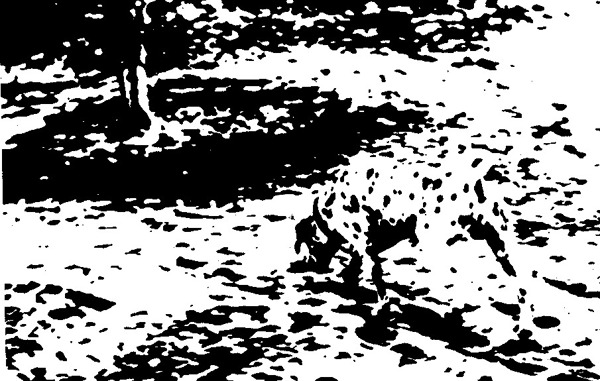 Figure 1: picture of a Dalmatian dog, well known in the field of visual perception.
When looking at this image, a process of identification occurs. We begin by seeing a series of blobs, which seem to be patterned in certain ways. These patterns inform our perception, and we attempt to fit certain forms - an object, an animal, a dog - to the blobs. We continue this back and forth, this bottom-up and top-down process, until we finally see: “It’s a dalmatian!”. Knowledge is acquired, and this back-and-forth process will no longer occur in subsequent viewings of this image.
From the point of view of cognitive processing, matter and form interact in such a way as to create intelligibility. According to Aristotle, we perceive objects in the world by receiving their form. Matter is perceived directly only when an object is unidentified, as with the image above. Aristotle’s view is close to that of Gestalt psychology which claims that organisms perceive entire pattern, not merely individual components.
Truth and knowledge
In the above, I have shown the importance of the “material quality, immaterial substrate” duality in religious, philosophical and scientific thinking. Whether they are called “Heaven” and “Earth”, “Form” and “Matter” or “Top-down” and “Bottom-up” processing, these concepts seem to help explain something important about the world. I will now explain how these dualities interact, and how their interaction is related to truth, falsehood and knowledge.
In the introduction, I’ve claimed that truth is the correct joining together of the material and the immaterial. In Table 1 below, I summarize and extend some of the categories.
As we have seen, in many mythologies and religions, the world is born of the creation of Heaven and Earth. When they are correctly joined together, the “primeval waters” retreat, and stable ground (i.e., truth) emerges. Civilization can only be built on stable ground. In ancient times, one’s civilization is the world indeed the further from the city one goes, the wilder the environment and wandering carries a high risk of death, be it by beast, savage or starvation. Because the correct joining of Heaven and Earth, creates stable ground, which enables civilization, and because civilization is the world, the correct joining of Heaven and Earth creates the world.
| The Immaterial | The Material |
|---|---|
| Heaven | Earth |
| Forms | Matter |
| Top-down | Bottom-up |
| Potentiality | Actuality |
| Theories | Facts |
| Ideas | Actions |
Table 1: Summary and extension of the immaterial and material dualities discussed so far
In more pragmatic language, we can also see how truth and knowledge emerges from the correct joining of form and matter. Consider again the example of the sculptor, the chunk of rock and the statue. It is self-evident that proclaiming the chuck of rock to a be a statue, and vice versa, is false. However, when one proclaims that the object is a statue, and the pattern of minerals are organized in such a way as to correspond to that, then that statement is true. If one recognizes this statement to be true, then one has acquired knowledge, because that correspondence of form and matter can be used to recognize truth again in the future.
This relationship expresses itself in science too. In some ways, the currency of science is theory. A good theory must be capable of both explaining why the facts present themselves in certain ways and predicting how these facts will present themselves in the future. Truth, then, corresponds to the correct joining of theory and fact: a theory is true when it can both predict and explain. If one has this theory in memory, and it is true, then one has knowledge of the world.
Conclusion
In this text, I’ve tried to show how viewing the world as a duality of material qualities and immaterial substrates is a useful, and indeed an ancient way of understanding reality. I’ve shown how the interaction of these dualities, and their correct connection is truth, and leads to knowledge of the world. I hope that having looked “under the hood”, this understanding of truth can be helpful in today’s morass of fiery statements found in our media.