
Why do we build rockets and invent vaccines? A neuropsychological account.
Introduction
Humans are undeniably a creative species. We are driven to design, invent, and build and today our technologies play an incredibly important part in our lives. As a species, we’ve made rockets to fly into space, vaccines to eradicate disease, and digital devices that allow us to communicate instantly from across the globe.
But why are we driven this way? Why do we desire pushing ourselves, our inventions, and the boundaries of our knowledge ever further? Despite trite spiritual sayings like “Life is about the journey, not the destination”, we are motivated to seek out, and attain our desires, moving from goal, to goal, to goal in a seemingly never-ending cycle. Indeed, desires, goals, and wants play an undeniable role in human life.
Is this goal directed behavior unhealthy for our mental and physical wellbeing? Should we do as these sayings suggest, and abandon the destination, to focus on the journey? In this essay, I will show that exploring our environment, and expanding our knowledge of it, is a core part of human nature by giving a neuropsychological account of the mesocorticolimbic pathway, also known as the “reward pathway” or more precisely the SEEKING system.
What is the SEEKING System?
Have you ever felt that feeling of intense anticipatory excitement, of not being able to wait a moment longer, like a child before her birthday? Have you ever felt that euphoric feeling of “being on the right track”, and wanting to continue engaging with whatever is the cause of that feeling? If so, you’ve felt the effect of the SEEKING system, and its main neurotransmitter: dopamine.
The SEEKING system plays a key role in human and animal behavior. It is responsible for foraging, exploration, investigation, curiosity, interest and expectancy. It leads organisms to eagerly pursue the fruits of their environment, which may be literal in animals or metaphorical in in humans. These fruits may be opportunities, friendships, love, sexual relations, knowledge and even higher meaning. Of course, love, friendship, and reproductive urges are not governed by the SEEKING system. However, the fulfillment of these desires require approach and active engagement with the world. Therefore, the SEEKING system occupies a central place in the brain.
Neuroanatomy and Neurochemistry
In Figure 1, we can see the main dopaminergic pathways in the brain. These pathways are those systems of neurons which use dopamine as their main way of transmitting information.
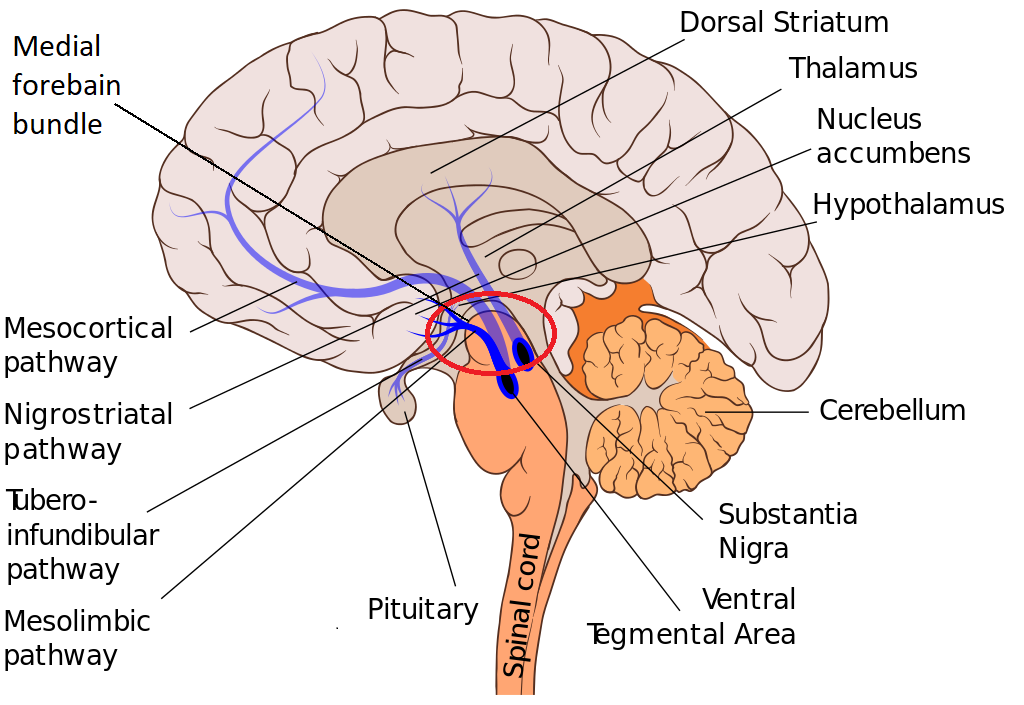 Figure 1: The main dopaminergic pathways of the human brain.
Dopamine is often portrayed as the neurotransmitter responsible for “pleasure”, however pleasure is not quite right. Dopamine mediates “motivational salience”, which signals the desirability or aversiveness of something, indicating to the organism to either approach or avoid. These “things” can be people, ideas, situations, objects, food, and more. When an organism is moving towards an important outcome, dopamine levels rise in the brain, generating a feeling of anticipatory excitement. This feeling therefore stands in sharp contrast to orgasmic pleasure, which is felt when the outcome is reached. This makes evolutionary sense: our ancestors needed to feel energized during a hunt, and excited at the idea of eating a delicious meal.
From a neuroanatomical perspective, the SEEKING system is composed of the mesolimbic and mesocortical pathways. These pathways join the midbrain - which is part of the basal ganglia, or the “reptilian brain” - to the limbic system, and the neocortex. This pathway therefore joins all three “parts” of the brain, which explains why urges for food begin populating our mind with thoughts of our favorite meals, and plans on how to acquire them. The other dopaminergic pathways are responsible for various motor and hormonal regulatory functions.
Dopamine plays a key role in these pathways, but other neurochemicals are also involved. For example, there are also massive contributions from descending systems mediated by the neurotransmitter GABA. Other neurotransmitters such as serotonin, norepinephrine, and neuropeptides such as orexin are also involved.
In sum, one can think of the mesocorticolimbic pathway as the trunk of an enormous tree spanning from the base of the brain all the way up to the neocortex. This tree is interwoven with a multitude of other neurochemical systems forming a complex web which modulate its activation. We can see how the neuroanatomy of the SEEKING system complements its role as a general-purpose approach mechanism, at least from a theoretical standpoint. From an empirical standing, many experiment provide additional evidence for the role of this neural pathway.
Evidence for the SEEKING System
For example, researchers observed that dopamine neurons in the median forebrain bundle (MFB) in animals, were typically aroused when the animal was searching for food, and promptly shut down when the food was found and feeding began: dopamine neurons were active during anticipatory phases, not in consummatory phases of behavior.
What’s more, Valenstein and colleagues showed that animals electrically stimulated in the MFB not only move forward in an energetically; vigorously sniffing, investigating, mouthing and manipulating prominent objects in their environment (i.e., they sought), the animals also switched behavior if the object they were interacting with was removed from their environment. This experiment demonstrated that the mesocorticolimbic pathway is related to a non-specific urge to approach and interact with the environment.
When the SEEEKING system is chemically, or electrically aroused in humans, the psychological urge reported is one of euphoria accompanied by increased behavioral engagement with the life-supporting elements of the world. People describe increased planning, sexual arousal, energy, agitation, curiosity, increased general motivation and a pressure to act.
Conclusion
To conclude, life is neither about the journey, nor the destination because one cannot exist without the other. As time passes, our organisms are kicked out of homeostasis and a survival-related destination rises from the depths and emerges into our consciousness. We then begin the journey, searching our environment for a way to satisfy it, until our organism is pushed out of homeostasis once again. This loop forms the basis of adaptive behavior and emanates from the mesocorticolimbic pathway.
The SEEKING system is so fundamental to survival that it is present in all vertebrates, from fish, to reptiles, to mammals, and probably appeared in early vertebrates about 500 million years ago. In humans, it plays a key role in our eternal search for wisdom, knowledge and understanding. It propels us towards a full comprehension of our social and physical environment. Just as an animal searches for “the stuff” in its environment which ensures its survival, humans search too for this “stuff”, and today we cure innumerable diseases, communicate instantly across the globe, and build rockets that fly into space.
Despite these incredible advances, we stand today on shaky ground. True knowledge seems hard to come by, as we sift through haystacks of disagreements and disinformation. In my next article I will discuss how knowledge is created, and how the world crumbles if this process is disturbed.